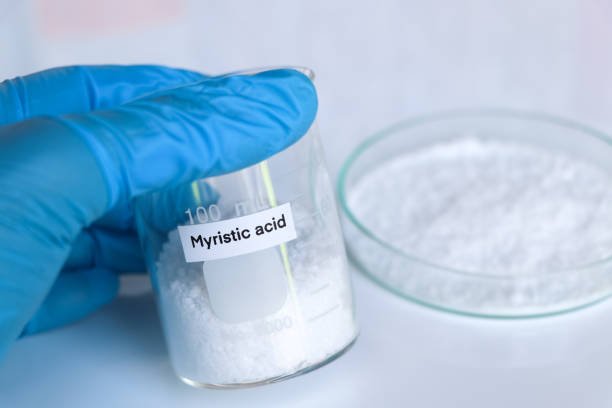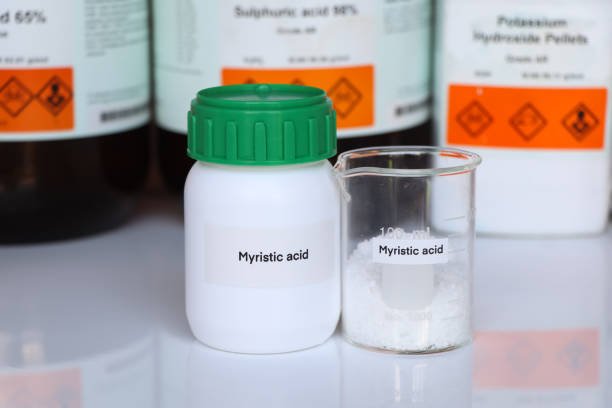
Myristic Acid
Myristic acid is a common saturated fatty acid with the molecular formula CH₃(CH₂)₁₂COOH. Its salts and esters are commonly referred to as myristates or tetradecanoates. It is named after the binomial name for nutmeg, from which it was first isolated in 1841 by Lyon Playfair.
- Overview
- Application
- Spesification
Overview
Myristic acid is a 14-carbon, unsaturated fatty acid (14:0) that is found in human cellular membranes at much lower levels than its longer chain length, saturated cousins palmitic acid (16:0) and stearic acid (18:0). Myristic acid is sufficiently hydrophobic to provide membrane-anchorage for the attached protein, but not hydrophobic enough for the binding to be permanent. For this reason, myristoylation is often the lipid handle of choice to attach signal proteins, such as the Src-family kinases, to the plasma membrane. Myristic acid acts as a lipid anchor in biomembranes. Reduction of myristic acid yields myristyl aldehyde and myristyl alcohol.
Myristic acid is attached to the protein's N-terminal glycine via an amide linkage. The reaction is catalyzed by N-myristoyl-transferase which uses myristoyl-CoA as the substrate. As with all newly synthesized eukaryotic proteins, the initial N-terminal amino acid is methionine that must be clipped off by PTM before a myristoyl is attached (a second PTM). Subsequent PTM events may also occur on this single protein. An example of an N-myrisoylated protein that has previously been discussed is rhodopsin, a transmembrane protein that features seven α-helices.
Myristic acid is directly involved in post-translational protein changes and mechanisms that control important metabolic processes in the human body. Myristic acid has a wide range of uses in various industries and manufacturing processes. You can find it in foods and beverages, in which it is used as a flow agent and emulsifier. It is a surfactant in soaps, detergents and textiles, as well as an intermediate, internal or external lubricant in plastics.
Application
Myristic acid has a wide range of uses in various industries and manufacturing processes. You can find it in foods and beverages, in which it is used as a flow agent and emulsifier. It is a surfactant in soaps, detergents and textiles, as well as an intermediate, internal or external lubricant in plastics. Isopropyl myristate, an ester of myristic acid, is used in the preparation of pharmaceuticals, cosmetics and personal care products to promote absorption through the skin.
- Surfactants and Esters: Anionic and Nonionic Surfactants for Chemicals, Textiles, Food, Soap & Detergent
- Food and Beverage: Flow Agent and Emulsifier
- Plastics: Intermediate, Internal and External Lubricant
- Soaps and Detergents: Anionic/Nonionic Surfactants
- Textiles: Anionic/Nonionic Surfactants
- Personal Care: Emulsifier for Facial Creams and Lotions
Spesification
| Specification | Typical Values |
| Acid Value (mg KOH/g) | 244-248 |
| Saponification Value (mg KOH/g) | 245-249 |
| Iodine Value (% I2absorbed) | 0.5 Max |
| Titre (oC) | 53-55 |
| Color (Lov, R/Y) | 0.2/ 2 Max |
| Composition (%) | |
| C12 | 1 Max |
| C14 | 99 Min |
| C16 | 1 Max |
| Others | 0.5 Max |
| Product Form | Liquid/ Solid/ Flakes / Beads |
| Packaging | 25kg Bag; Bulker Bag; ISO; Bulk |